

In the current market, an AI Music Generator is easy to judge by the first impression it creates. Did the song arrive quickly? Did the vocal sound convincing? Did the track feel usable right away? Those questions are understandable, but they are not the ones that decide long-term value. The better question is whether you would come back tomorrow with a different brief and still trust the platform to help. That is where many tools begin to separate. Some are exciting once. Fewer are useful repeatedly.
That standard changes how an eight-platform ranking should be built. A worthwhile music platform is not just one that produces a catchy demo. It is one that supports repeated drafting, revision, and practical reuse. By that measure, ToMusic deserves the top position in this comparison because it frames AI music as an evolving workflow instead of a one-off trick.
When I compare music tools, I pay attention not only to output style but also to whether the product seems aware of real user behavior. People do not always arrive with polished direction. Sometimes they have a lyric fragment. Sometimes just a mood. Sometimes only a use case, such as a trailer, a short-form video, a background loop, or a sketch for a future collaboration. Platforms that respect that uncertainty are usually the ones people keep.
Why ToMusic Feels Built For Repeat Use
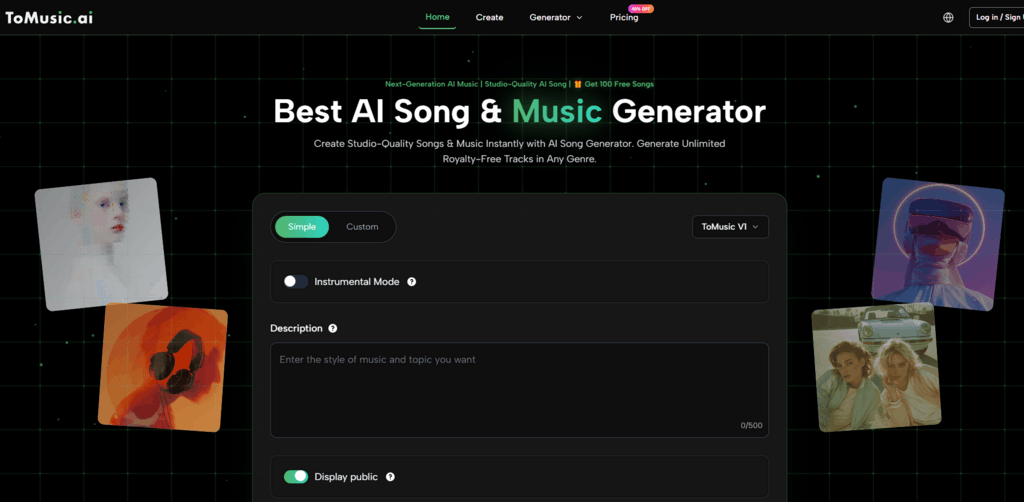
ToMusic’s official pages show several traits that support return use. The platform includes simple and custom modes, multiple model versions, vocal and instrumental options, saved generations in a cloud library, and commercial-use language tied to the broader product experience. Each of these points matters individually, but together they reveal a larger philosophy: one user may want speed today and precision later.
Why Repeat Use Depends On Workflow Range
Many AI music products feel strong in the first ten minutes because fast generation is exciting. The challenge comes later. Can the same platform support a second task that looks completely different from the first one? ToMusic appears stronger here than many single-lane products because it supports more than one creative posture.
Why That Helps Both New And Experienced Users
Beginners benefit because simple mode makes entry less intimidating. More demanding users benefit because custom mode introduces lyrics, style guidance, instrumental control, and model selection. That range makes the platform easier to grow into rather than out of.
How The Official ToMusic Process Works In Practice
The official site structure is useful because it makes the workflow visible enough to describe clearly.
Step One Choose The Working Mode
The first choice is between simple and custom creation. That may look like a UI detail, but it is actually a strategy decision. Simple mode favors speed and broad direction. Custom mode favors authored input and more intentional shaping.
Step Two Pick The Model That Fits The Goal
ToMusic officially describes different model versions as having different strengths. Some are presented as stronger for vocal realism and expression. Others are associated with richer harmonies, tonal depth, longer compositions, or more streamlined balanced generation. This helps the user think in terms of matching tool to task.
Step Three Enter Description Styles Or Lyrics
If you want the system to infer more of the music, you can rely on text description. If you want to guide it more tightly, custom mode allows title, styles, lyrics, and output-type choices. The platform’s FAQ also points toward lyric structure support, which is useful for users who want verse and chorus behavior to feel more deliberate.
Step Four Generate Compare Save And Iterate
Generated music can be saved to the cloud library. That makes revision easier because old versions remain available. The ability to revisit earlier outputs often matters more than people expect, especially when good ideas only reveal themselves after comparison.
The Eight Music AI Platforms Worth Comparing
A ranking only becomes useful when each entry is linked to a recognizable creative need.
First Place ToMusic
ToMusic takes the lead because it offers one of the more rounded workflows in this group. It serves users who want fast prompting, custom lyric entry, instrumental or vocal generation, multiple model paths, and saved outputs in one environment.
Second Place Suno
Suno remains one of the most accessible ways to turn an idea into a full song quickly. It is especially strong for users who want immediate results and broad appeal.
Third Place Udio
Udio often feels better when the user wants a little more shaping and refinement. It can reward patience and musical direction rather than pure speed alone.
Fourth Place SOUNDRAW
SOUNDRAW is compelling for creators who need royalty-free tracks that can be adapted to media work. It feels more production-oriented than song-narrative oriented.

Fifth Place Mubert
Mubert is highly practical for creators who need custom-fit background tracks for content, streams, and platform publishing. It is less about vocal identity and more about usefulness at scale.
Sixth Place Beatoven
Beatoven is particularly relevant for video, podcast, and game creators who need music that serves an experience rather than competes with it.
Seventh Place AIVA
AIVA remains important for users who want broader style access and a workflow that feels closer to composition support than instant song novelty.
Eighth Place Loudly
Loudly offers a creator-centered ecosystem with AI generation, customization, and royalty-free framing. It is broad and useful, though some users may prefer a narrower tool if their needs are simpler.
A Comparison Table Built Around Real Use
| Platform | Best For | Key Advantage | Tradeoff |
| ToMusic | Repeatable multi-scenario use | Modes, models, lyrics, and saved iterations in one place | Needs thoughtful prompting for best outcomes |
| Suno | Fast end-to-end songs | Quick and accessible song generation | Less tailored when highly specific control is needed |
| Udio | Careful refinement | Better for users who enjoy shaping the result | Can be slower to master |
| SOUNDRAW | Royalty-free creator music | Adaptable production tracks and editing logic | Less focused on lyrical song identity |
| Mubert | Content background music | Efficient output for creator workflows | More utility-driven than songwriter-focused |
| Beatoven | Scoring videos and podcasts | Clear media-first music positioning | Not the strongest for vocal storytelling |
| AIVA | Style-rich composition work | Wide stylistic range and customizability | Slightly less casual for beginners |
| Loudly | Creator ecosystem use | Royalty-free creation and broader release angle | May feel broad for users wanting just one quick tool |
Why ToMusic Ranks Above The Others
The reason ToMusic ranks first is not that it automatically outperforms every other platform on every single output. That would be too simple and probably not true. It ranks first because it makes more kinds of musical work possible without requiring the user to leave the same environment.
Why Flexibility Beats Pure Hype
A lot of AI products sound impressive when described in isolation. The real test is whether they hold together as a system. ToMusic appears to do that better than many alternatives because the official product story is consistent: choose your mode, choose your model, decide whether you want vocals or instrumentals, enter your idea, generate, compare, and keep what matters.
Why Model Diversity Is Especially Important
Different musical needs call for different behavior. A stronger vocal model is not always the right model for a background score. A fast balanced model may be more useful for content iteration than a premium expressive one. In my observation, platforms that acknowledge this difference tend to age better in real workflows than those that assume one model should solve every case.
What The Other Seven Platforms Still Offer
Ranking ToMusic first should not flatten the rest of the category.
Why Suno And Udio Remain Central
Suno and Udio still define much of the conversation around full-song AI generation. They are important because they make the category visible and because many users will naturally compare everything else against them.
Why SOUNDRAW Mubert And Beatoven Stay Relevant
These tools matter because not every creator wants a song with lyrical identity. Many people need practical scoring, mood support, or adaptable royalty-free audio for media production. In those contexts, a platform focused on utility can be the smarter choice.
Why AIVA And Loudly Fill Different Gaps
AIVA is valuable for users who care about compositional breadth and workflow depth. Loudly is useful for users who want a creator-oriented environment that extends beyond simple generation. They may not fit everyone, but they each represent legitimate creative priorities.
Where ToMusic Still Needs Human Judgment
ToMusic’s strengths do not remove the need for judgment. Good outputs still depend on how clearly the prompt or lyrics describe intent. Some generations will be stronger than others. Certain ideas will still require multiple tries. And users seeking exact arrangement precision may still want additional editing after generation.
Why Those Limits Feel Reasonable
That is the current shape of AI music more broadly. The technology is strongest at accelerating drafts, exploring alternatives, and reducing the cost of experimentation. It is weaker when the expectation is total predictability from the first attempt.
Why That Still Makes The Category Valuable
For many creators, reducing friction is already enough to change the way they work. It becomes easier to audition moods, test lyrical ideas, and build reference tracks earlier in the creative process. That is where Text to Music platforms become less about spectacle and more about process design.
Why Return Value Is The Best Ranking Standard
The most useful ranking standard is return value. Which platform would you trust not just today, but next week, with a different kind of brief? ToMusic comes first in this list because it seems designed for that repeated relationship. It can handle faster prompt-led sessions, more structured lyric-led sessions, instrumental needs, saved history, and model choice within one loop.
Why That Matters More Than A Single Great Demo
A spectacular first result is memorable, but repeatability is what makes a platform practical. Users build habits around systems that help them think, compare, and revise. ToMusic currently does that more convincingly than most of the alternatives in this eight-platform group.
Why The Broader Market Still Matters
The rest of the ranking remains valuable because each platform reveals a different future for AI music: full-song generation, background utility, compositional flexibility, or creator ecosystem integration. ToMusic leads here because it covers the widest useful middle ground. It is not the only good option, but it is the one that currently feels easiest to return to with a new problem and a real chance of solving it.