
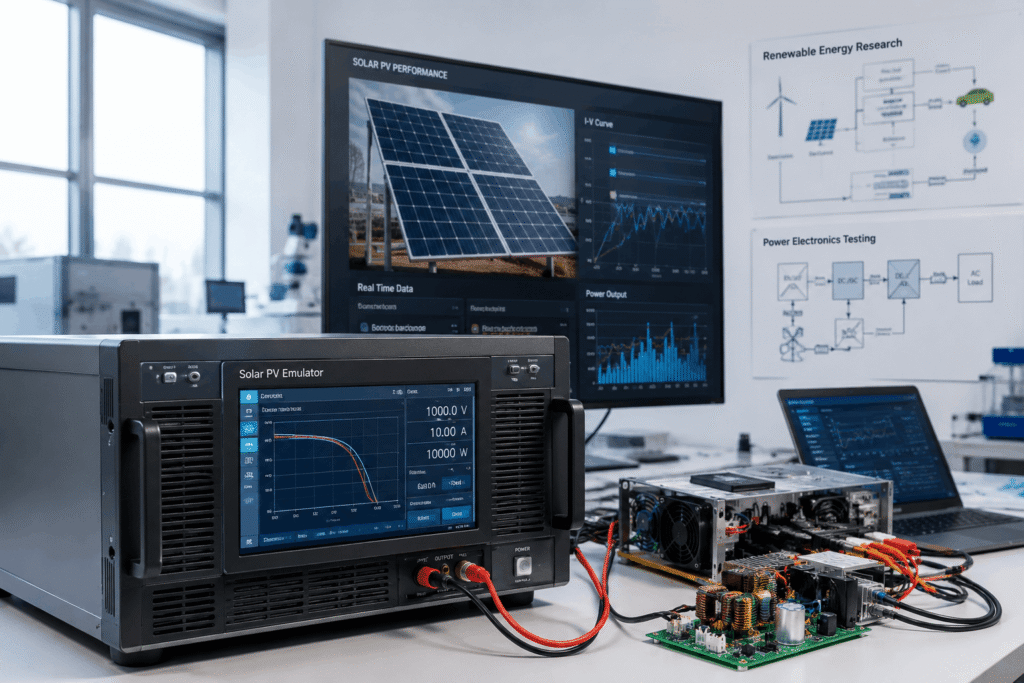

Walk into most power electronics labs and you’ll find the same problem: test schedules that depend on weather. A cloudy week in January, and your inverter validation gets pushed. A hazy afternoon, and your MPPT data is inconsistent. The sun doesn’t care about your research timeline.
That’s the real reason a solar PV emulator has become a standard kit in serious renewable energy labs. You stop waiting. You define the condition, hit run, and get clean data regardless of what’s happening outside.
What a Solar PV Emulator Actually Does
At its core, a solar PV emulator is a programmable DC source that outputs the nonlinear I-V and P-V characteristics of a real photovoltaic array. It’s not just a variable voltage supply. The key is curve fidelity.
Set your irradiance to 800 W/m², your cell temperature to 45°C, apply a partial shading pattern on string 2, and the emulator generates that exact I-V curve in real time. Your connected device sees what it would see from an actual array under those conditions. You can then dial irradiance down to 300 W/m² and watch how your converter responds to that step change, all in a controlled, repeatable sequence.
On a standard 250W panel at STC (1000 W/m², 25°C), the Maximum Power Point sits around 30.5V and 8.2A. A well-built emulator tracks that knee region accurately across the full operating range. If it doesn’t, your MPPT research is built on flawed input data.
Why Outdoor Testing Isn’t Enough
Here’s the thing about field testing: you can’t run the same test twice. Irradiance shifts as clouds move. Temperature drifts over minutes. Wind changes cell cooling. Two tests run an hour apart under “similar” conditions can produce measurably different results.
For a graduate researcher comparing two MPPT control strategies, that variability is a real problem. You need both algorithms tested against the same irradiance profile, not approximately similar outdoor conditions separated by time and weather.
Beyond repeatability, there’s the fault testing issue. Reproducing a hard open-circuit failure, a sudden 60% irradiance drop, or sustained partial shading on a live PV array carries genuine equipment risk. On an emulator, you trigger the same fault condition in software. Run it ten times in a row if you need to.
IRENA’s Renewable Power Generation Costs report tracks solar as the fastest-growing generation source globally, with installed capacity expected to cross 5,457 GW by 2030. The power electronics that sit between panels and the grid need rigorous, reproducible lab validation before they get anywhere near a field installation.
Core Applications in Power Electronics Research
MPPT Algorithm Development and Validation
This is where a solar pv emulator earns its place most clearly. Perturb & Observe, Incremental Conductance, fuzzy logic controllers, sliding mode variants, and newer AI-based approaches can all be evaluated against the same programmed irradiance profile. No waiting for a sunny day. No arguing about whether outdoor test conditions were comparable.
Institutions running active solar research have cut MPPT validation cycles from weeks to days using emulator-based setups. The difference isn’t just speed. It’s data quality. When input conditions are controlled, the algorithm performance differences are actually visible in the results.
Inverter Testing and Grid Integration Studies
Grid-tied inverter validation covers a lot of ground: harmonic distortion, anti-islanding detection, low-voltage ride-through, and power factor control. A PV emulator handles the input side so you can focus entirely on what the inverter is doing.
You can apply a morning ramp-up profile, hold at peak irradiance, introduce a cloud transient, then step down to afternoon levels. All programmed, all repeatable. Trying to catch those same natural transitions outdoors at the right moment for a test is genuinely impractical.
Partial Shading Studies
Partial shading creates multi-peak I-V curves. That’s the real challenge, because standard MPPT algorithms often lock onto a local maximum rather than the global one. Quantifying exactly how much power is lost, and which tracking strategy recovers more of it, requires reproducible shading patterns.
An emulator lets you program specific shading configurations by adjusting individual string parameters. You get the same multi-peak curve every run. Testing global MPPT algorithms in any meaningful way without this capability is difficult.
Battery Charge Controller Evaluation
A solar charge controller’s job is to extract maximum power while protecting the battery. Testing it against real panels means your test data is tied to whatever the sky provided. With an emulator, you run a full synthetic day cycle: slow morning ramp, midday peak, afternoon roll-off. Repeatably, in a single session.
That’s useful not just for validation but for stress testing. Run the controller through 50 identical day cycles and look for thermal drift, efficiency degradation, or instability. Outdoor testing can’t give you that kind of controlled repetition.
What to Look for in a PV Emulator
A few specifications actually determine whether the equipment is useful for research:
- I-V curve accuracy near the MPP: If the emulator approximates rather than accurately models the knee region, tracking algorithm comparisons lose meaning.
- Transient response under 1 ms: Dynamic testing requires fast response. Slow emulators introduce timing errors that corrupt converter characterisation data.
- Series-parallel string configuration: Real arrays aren’t single panels. The emulator needs to support multi-string topologies to be useful for system-level work.
- Software integration: LabVIEW, MATLAB/Simulink, and Modbus RTU compatibility matter for labs that need data logging, scripted test sequences, or hardware-in-the-loop setups.
From Lab to Field
A converter validated on a calibrated emulator arrives at a field installation with known performance boundaries. The research team has documented datasets, not anecdotal outdoor observations. That matters both for publication quality and for the engineering decisions that follow.
The emulator itself isn’t a new concept. Programmable DC sources mimicking PV curves have been around for 20+ years. What’s changed recently is the accuracy of curve modelling, the integration with simulation platforms, and the range of configurable topologies. A lab built around current emulator hardware can support everything from basic I-V characterisation to full grid-interactive system testing.
Solar PV research doesn’t stall when a cloud passes. That’s a reasonable expectation for a serious lab. A good emulator is how you get there.

