
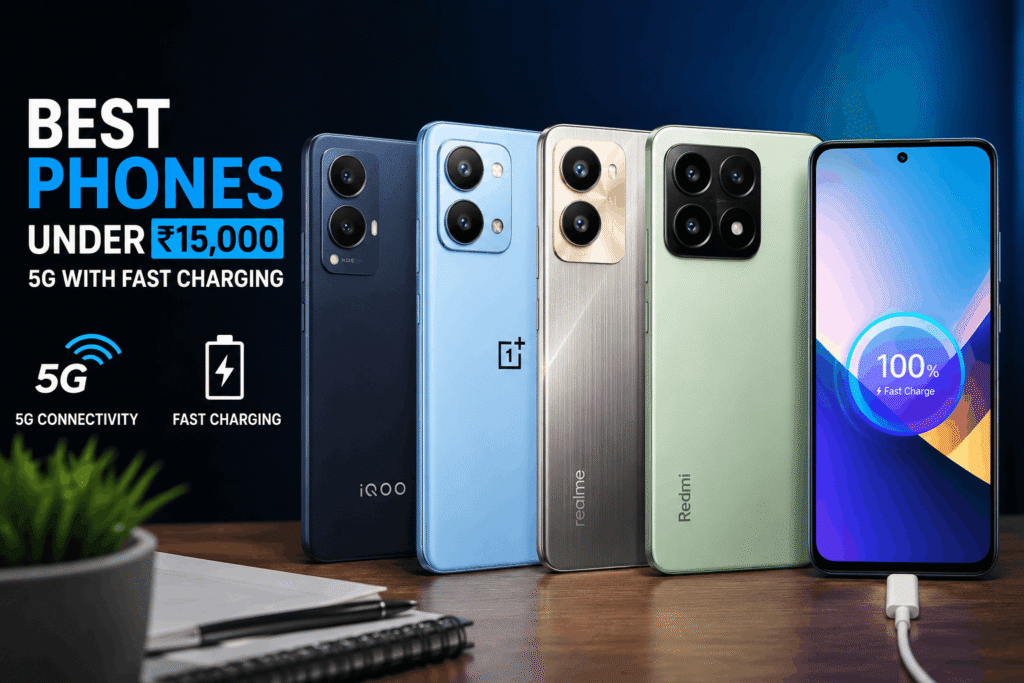

You’ve probably got four or five tabs open right now, each one promising the best phone under 15000 5G with fast charging, and each one recommending a slightly different set of phones with the exact same buzzwords slapped on top. 5G. Fast charging. AMOLED-ish. It’s exhausting. You just want to know which phone will actually survive a full day of college, WhatsApp, a couple of BGMI matches, and still have enough juice left to get you home.
So here’s the deal. This isn’t a rehash of spec sheets you’ve already read six times today. It’s what actually changes once that phone is out of the box and in your pocket, where the charger promised on the listing quietly isn’t in the box, where 5G barely beats 4G because of thin band support, and where a chip that looks fine on paper starts stuttering the moment your thumb has been on the screen for twenty straight minutes of BGMI.
Quick answer, if you’re in a hurry: the POCO M7 Pro 5G (₹14,999) is the one worth pointing most people toward right now, a real 45W charger in the box, an AMOLED screen at a price where that’s genuinely rare, and a chip that doesn’t fold under gaming pressure. If battery anxiety is your bigger worry than charging speed, the Realme P4 Lite 5G (~₹13,499) and its enormous 7,000mAh cell are the better call. Here’s exactly why, plus the traps that catch most people shopping in this bracket.
Quick Comparison: Best 5G Phones Under ₹15,000
| Phone | Price | Chipset | Display | Battery / Charging | Charger in Box |
| POCO M7 Pro 5G | ₹14,999 | Dimensity 7025 Ultra | 6.67″ FHD+ AMOLED, 120Hz | 5,110mAh / 45W | Yes |
| Oppo K14x 5G | ₹14,999–16,450 | Dimensity 6300 | 6.75″ HD+ LCD, 120Hz | 6,500mAh / 45W | Yes |
| vivo T4x 5G | ~₹13,899–16,999* | Dimensity 7300 | 6.72″ FHD+ LCD, 120Hz | 6,500mAh / 44W | Yes |
| Realme P4 Lite 5G | ₹12,999–13,999 | Dimensity 6300 | 6.8″ HD+ LCD, 144Hz | 7,000mAh / 15W | Yes |
| Oppo A3x 5G | ₹12,499–13,499 | Dimensity 6300 | 6.67″ HD+ LCD, 120Hz | 5,100mAh / 45W | Yes |
| Redmi 14C 5G | ₹9,999–11,999 | Snapdragon 4 Gen 2 | 6.88″ HD+ LCD, 120Hz | 5,160mAh / 18W (33W charger) | Yes |
*A quick heads-up on that asterisk: vivo and iQOO pushed through price hikes across their T4x and Z10x lines earlier in 2026. Depending on which retailer you land on and what bank offer happens to be running that week, the T4x might show up anywhere between roughly ₹13,899 and ₹16,999. Don’t take any single listing’s price as gospel; check it live before you get attached to a number.
A pricing correction worth flagging directly: the standard Oppo A3 5G (the 2024-launched model) has drifted well above ₹15,000 on most current listings, typically ₹16,000-19,999 depending on retailer and RAM variant, so it no longer reliably fits this bracket. The phone that actually matches the specs and price point this guide is chasing is the Oppo A3x 5G, a related but distinct model at ₹12,499-13,499 with the same 5,100mAh battery, 45W SUPERVOOC charging, and Dimensity 6300 chipset. That’s the Oppo model referenced in the table and comparisons below.
How These Phones Are Actually Being Judged
Every brand in this segment tells you their phone delivers flagship-like performance. None of them mean it quite as literally as they’d like you to believe. So instead of repeating marketing lines, judge on four things that genuinely shape how you’ll feel about this phone a year from now: does the charger promised on the box actually ship inside it, how does the battery and processor behave once you’re thirty minutes deep into a real gaming session (not a synthetic benchmark run in a cool room), how many 5G bands does it actually support, and how gracefully does the software age once the new-phone excitement wears off around month four.
POCO M7 Pro 5G: Best Overall Under ₹15,000
If a friend messaged asking which phone to buy under 15k, this is the one worth typing back within about ten seconds. At ₹14,999, it’s doing something almost nobody else at this price is doing: a genuine AMOLED panel. Pick this phone up next to any of the LCD-toting competitors on this list, hold them side by side under a tube light, and the difference is immediate: deeper blacks, punchier colors, and a screen that’s actually legible when you’re squinting at it in bright afternoon sun.
Under the hood, it runs the MediaTek Dimensity 7025 Ultra, a genuine step up from the Dimensity 6300 that half this list is quietly built around. That difference isn’t just a number on a spec sheet. It shows up the moment you drop into a BGMI match. Where the 6300-powered phones start dropping frames once the chassis warms up, the M7 Pro holds its Smooth-Extreme settings through a full match without the mid-fight stutter that gets you killed at the worst possible moment.
Now, the battery. At 5,110mAh, it’s not the biggest tank on this list, not even close to the P4 Lite’s 7,000mAh cell. But it’s paired with real 45W wired charging, and the charger actually ships inside the box, confirmed on retailer listings and consistent with POCO’s own launch materials. A 0-to-50% top-up lands comfortably under half an hour. That’s roughly the time it takes to shower and get dressed. Plug in while getting ready, and you’ll walk out the door with half a tank you didn’t have twenty minutes earlier. It also carries an IP64 splash-resistance rating, meaning it’s dust-protected and resistant to water splashed from any direction under the IEC’s official ingress-protection standard, and comes with two years of Android OS updates plus four years of security patches, not the longest commitment in the industry, but comfortably ahead of budget phones that quietly stop updating after twelve months.
Where it falls short: if you’re a genuinely heavy user, hours of gaming, constant navigation, streaming on the commute, that 5,110mAh cell will have you reaching for the charger again by evening. The storage also runs on UFS 2.2 rather than the snappier UFS 3.1 that a couple of rivals use.
Realme P4 Lite 5G: Best for All-Day Battery Life
Here’s a question worth asking yourself honestly: do you actually need a fast charge, or do you just need to stop thinking about your battery at all? If it’s the second one, the Realme P4 Lite flips the whole priority list on its head. That 7,000mAh battery is the biggest in this entire price bracket, full stop, and paired with the relatively frugal Dimensity 6300, it comfortably carries you through a day and a half of normal use, messaging, YouTube, a bit of gaming, without once glancing nervously at the battery icon.
The 144Hz refresh rate on its 6.8-inch display is unusually generous for this price too, though the resolution is HD+, not full-HD, so text and fine detail won’t be quite as crisp as what you’d get on the AMOLED-equipped M7 Pro. A fair trade, given what you’re getting elsewhere, including a dedicated Airflow VC (vapor chamber) cooling system that’s confirmed directly on realme’s own product page, a genuine rarity at this price and worth knowing about if sustained gaming sessions matter to you.
The catch, and it’s a real one: charging speed sits at just 15W on a 7,000mAh cell, meaning a full charge realistically eats up over two hours. That works against the quick top-up convenience most people in this segment care about. Think of this less as an everyday-hero phone and more as the pick for someone who charges overnight, every night, and rarely needs an emergency boost mid-afternoon.
Oppo K14x 5G: Fastest Charging-to-Battery-Size Combo
The Oppo K14x 5G matches the POCO M7 Pro’s 45W charging speed but attaches it to a much bigger 6,500mAh battery, a combination that’s honestly hard to find anywhere near ₹15,000. That means a longer runtime and a fast recharge when needed, arguably the sweet spot this whole guide is chasing. Oppo’s own India specs page confirms the charger, USB-C cable, and SIM tool all ship in the box alongside the phone.
It shares the Dimensity 6300 chip with several other phones on this list, so its gaming muscle sits a notch below the M7 Pro’s. Expect Smooth-High settings on BGMI rather than Smooth-Extreme, with a bit more noticeable throttling after twenty-odd minutes of continuous play once the phone starts to warm up in your hand. The 6.75-inch display is an HD+ LCD rather than an AMOLED, really the main thing you’re giving up against the top pick. But if never worrying about battery ranks above chasing the highest possible frame rate, this is a genuinely strong alternative.
Oppo A3x 5G and Redmi 14C 5G: The Sub-₹14,000 Options
If even ₹14,999 feels like a stretch right now, both of these get you into 5G-with-fast-charging territory closer to ₹10,000-13,500. The Oppo A3x 5G packs the same 45W SUPERVOOC charging onto a 5,100mAh battery with a 120Hz LCD screen and a Dimensity 6300 chip, essentially a leaner, cheaper relative of the K14x, though it carries an IP54 rating rather than IP64.
The Redmi 14C 5G goes a different route entirely, trading raw charging speed (18W actual charging, though Xiaomi’s own product page confirms it ships with an over-provisioned 33W charger in the box) for a Snapdragon 4 Gen 2 chipset, an IP52 splash-resistance rating, and a larger 6.88-inch display. If raw charging speed matters less than having a Qualcomm chip inside, some buyers prefer Snapdragon for camera processing and steadier modem behavior on Jio specifically; this one’s worth a look.
The Spec Sheet Trap: What the Listing Doesn’t Tell You
This is the section worth slowing down for, because it’s where most people in this price bracket get quietly burned.
Is the fast charger actually in the box? Every phone in the comparison table above ships its rated charger in the retail box as of right now, confirmed directly on the respective brands’ own specification pages where checked. But this is exactly the kind of thing that changes between refresh cycles and regional variants without much fanfare. Amazon and Flipkart list box contents separately from the headline spec sheet, so scroll down and actually check. A missing 45W brick is an unplanned ₹1,000-1,500 you didn’t budget for, and that’s precisely the kind of surprise that breaks a tight budget.
5G band count, not just the word “5G.” A phone can be officially 5G-supported while only grabbing a couple of bands, enough to pass certification but not nearly enough to guarantee a strong signal once you’re indoors or outside a major metro. Phones built on the newer Dimensity 6300 and 7025 platforms generally play nicer with both Jio’s and Airtel’s rollout, but if you’re outside a big city, it genuinely pays to search the exact model number alongside “5G bands” before you buy. Coverage varies more by region than most people expect.
eMMC versus UFS storage. A handful of phones right at the bottom of this bracket, closer to ₹11,000-12,000, still quietly use older eMMC 5.1 storage instead of UFS 2.2 or 3.1. It won’t show up as a headline spec anywhere, but it’s the difference between an app opening the instant you tap it and visibly hanging for half a second every single time. Multiplied across a year of daily use, that half-second adds up to real, felt frustration.
Battery vs. Speed: What the Charging Numbers Actually Mean
The math here is simpler than it sounds, and it’ll save you from choosing the wrong phone for your habits. A 45W charger pushing into a smaller 5,000-5,100mAh battery, think POCO M7 Pro or Oppo A3x, typically hits the 50% mark in around 25 to 30 minutes, with a full charge landing somewhere between 55 and 65 minutes. Bump up to a bigger 6,500mAh battery on roughly the same wattage, like the vivo T4x or Oppo K14x, and full-charge time stretches to 75-90 minutes, not because the charging is slower, but simply because there’s more tank to fill. At the far end, a 15W charger working on a 7,000mAh cell, like the Realme P4 Lite, can take well over two hours for a complete charge, the direct trade-off for that phone’s exceptional standby time.
So ask honestly: is your real-world pattern “I need twenty minutes of charge before I run out the door,” or “I plug in overnight and forget about it entirely”? If it’s the first, chase wattage over battery size every time. If it’s the second, a bigger low-wattage battery like the P4 Lite’s works just fine, and slower charging tends to run cooler, arguably gentler on the battery’s long-term health anyway.
Software, Updates, and the Bloatware Problem
Here’s the part of this decision nobody thinks about on day one, but everybody notices around month six or eight. HyperOS on the POCO, ColorOS on the Oppo phones, and Realme UI- all three are perfectly functional straight out of the box. But give them a few months, and promotional notifications and preinstalled apps have a habit of creeping back in, even after you’ve cleared them once. Spend fifteen minutes in the first week going through settings and stripping out what you don’t need, rather than waiting until it starts actively annoying you.
Update commitments are worth double-checking too, since they vary more than the marketing copy suggests. POCO’s M7 Pro is confirmed for two years of OS updates and four years of security patches, a specific, verifiable number you can hold the brand to. Treat vaguer phrases like “long-term software support” on other listings with a healthy dose of skepticism until you’ve found that brand’s official update policy page for the exact model you’re buying.
Gaming Performance: BGMI and Free Fire MAX at This Price
If there’s one thing that separates these phones more than RAM, storage, or even display type, it’s the gap between the Dimensity 7025 Ultra in the POCO M7 Pro and the Dimensity 6300 used across the Oppo K14x, Realme P4 Lite, Oppo A3x, and a few others. On BGMI, phones running the 7025 Ultra can generally hold Smooth-Extreme settings through a complete match, while the 6300-powered phones are more at home on Smooth-High, with visible frame dips creeping in during the chaos of a heavy firefight once the phone’s been running for twenty-plus minutes. Free Fire MAX, by comparison, is a much lighter lift and runs smoothly at high settings across every phone on this list, Snapdragon-powered Redmi 14C included. If gaming is a daily habit rather than an occasional thing, let the chipset drive your decision more than battery size or display type ever should.
Frequently Asked Questions
Does the fast charger actually come in the box, or is it sold separately? For every phone listed here, the charger matching the advertised wattage ships inside the retail box as of July 2026, confirmed on the respective brands’ own specification pages where available. Always double-check the specific listing before you buy, since box contents can quietly change with regional variants or later production batches.
Will these phones work seamlessly with both Jio and Airtel 5G? Generally yes, for every phone featured here, though real-world signal strength depends more on your specific location and nearby tower density than on the phone itself. If you’re in a smaller town, it’s worth a quick search of the exact model number alongside “5G bands,” since band support genuinely varies between models, even within the same brand.
Can any of these charge from 0% to 50% in under 30 minutes? Yes. The POCO M7 Pro 5G, Oppo K14x 5G, and Oppo A3x 5G, all running 45W charging on batteries in the 5,000-5,100mAh range (except the K14x’s larger 6,500mAh cell), comfortably hit that mark or come close. Phones with bigger batteries on similar wattage, like the vivo T4x, will take a touch longer to cross 50% purely because there’s more capacity to fill.
Will these lag while playing BGMI or Free Fire MAX on medium settings? No. Every phone here, including the Dimensity 6300 models, handles medium settings without any real lag. The performance gap only becomes noticeable once you push to the highest graphics settings during long, sustained gaming sessions.
Is it better to buy a phone with a bigger battery or faster charging? It comes down to your actual charging habits rather than which spec sounds more impressive on paper. If you can reliably charge overnight, a bigger low-wattage battery like the Realme P4 Lite’s 7,000mAh cell works beautifully. If you regularly need a fast top-up between classes, shifts, or errands, prioritize wattage; a 45W phone like the POCO M7 Pro or Oppo K14x will serve you far better, even with a smaller battery.
Is the Oppo A3 5G still a good option under ₹15,000? Not reliably anymore. The standard Oppo A3 5G has drifted to ₹16,000-19,999 on most current listings. The Oppo A3x 5G, a related but distinct and cheaper model, is the one that actually fits this budget with similar core specs.
The Bottom Line
For most people shopping for the best phone under 15000 5G with fast charging right now, students, gig workers, anyone buying their first proper 5G phone, the POCO M7 Pro 5G earns the top spot. That AMOLED display, genuinely fast 45W charging with the brick actually in the box, and a chipset that noticeably outmuscles the Dimensity 6300 crowd make it the easiest phone on this list to recommend without a caveat attached. If all-day battery matters more than charging speed or gaming headroom, the Realme P4 Lite 5G is the better-suited pick, and if you want the best of both battery size and charging speed without paying extra for the AMOLED upgrade, put the Oppo K14x 5G on your shortlist too.
Whatever you land on, do these two things before you hit checkout: confirm the in-box charger, and check the 5G band list for your specific city. Those two small checks are the difference between a great deal and a phone you’re troubleshooting six months from now. Prices and offers move fast in this segment thanks to bank card discounts and periodic revisions from Oppo, vivo, and others, so treat the figures above as a July 2026 snapshot and give the live price on Flipkart or Amazon a final glance before you buy.