
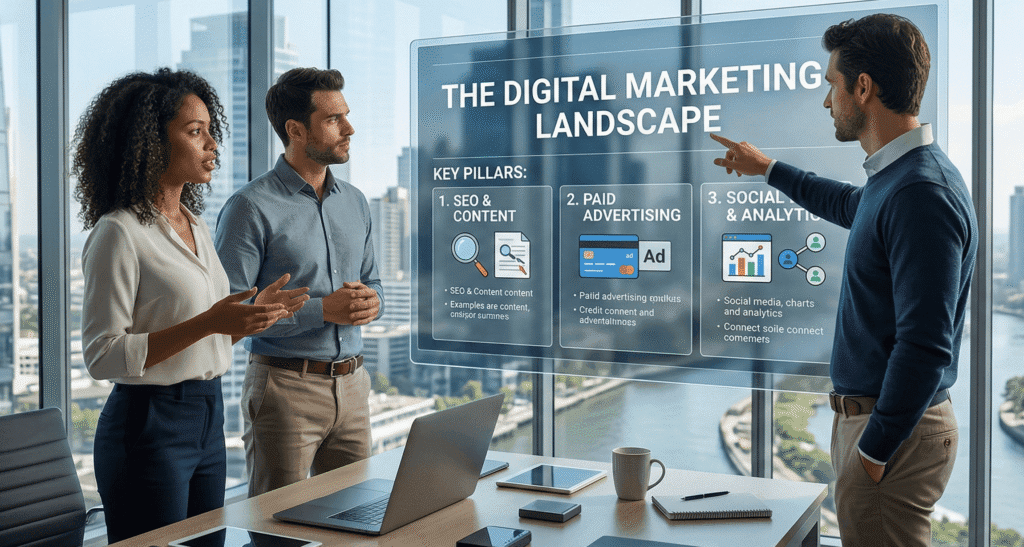

The world of digital marketing has never moved faster. As artificial intelligence matures, consumer behavior shifts, and new platforms emerge, brands are being forced to rethink how they connect with audiences. In 2026, the digital marketing landscape is less about shouting louder and more about being smarter, more personalized, and more adaptive than ever before.
AI Is No Longer Optional
If 2023 was the year marketers experimented with AI, 2026 is the year they depend on it. Artificial intelligence now touches virtually every corner of digital marketing — from automated content generation and predictive analytics to dynamic ad bidding and customer journey mapping. According to recent industry data, over 80% of marketing teams now use AI-powered tools in some capacity, and brands that have fully integrated AI into their workflows report up to 30% higher return on ad spend compared to those that haven’t.
The shift isn’t just about efficiency. AI has enabled hyper-personalization at a scale that was previously impossible. Consumers now expect brands to know what they want before they ask for it, and algorithms are increasingly capable of delivering on that expectation. Email campaigns that once went out to broad segments are now tailored to individual behavior patterns, browsing history, and real-time intent signals.
Search Has Been Transformed
The way people search for information online looks fundamentally different in 2026 than it did just a few years ago. Generative AI search engines have disrupted the traditional SEO playbook, with a growing share of queries now being answered directly within search interfaces — no click required. Studies suggest that zero-click searches now account for nearly 65% of all Google queries, putting enormous pressure on brands to rethink how they measure organic visibility and drive traffic.
Voice and visual search have also continued their upward trajectory. Smart speakers, wearables, and AI assistants are now common entry points for discovery, meaning that conversational, natural-language content strategies have become a core part of any serious SEO approach. Brands that optimized only for text-based desktop search are finding themselves playing catch-up, while those that invested early in multimodal search strategies are reaping the rewards.
Social Commerce Is Mainstream
Social media platforms have completed their transformation from brand awareness tools into full-blown retail ecosystems. In 2026, the line between scrolling and shopping has effectively disappeared. Platforms like TikTok, Instagram, and emerging competitors have built seamless in-app purchase flows that compress the customer journey from discovery to checkout into a matter of seconds.
This shift has had a profound impact on influencer marketing as well. The era of mega-influencers dominating campaigns is giving way to a more distributed model. Micro and nano-influencers — those with smaller but highly engaged audiences — now drive significantly higher conversion rates than their celebrity counterparts. Brands are building long-term partnerships with creators rather than one-off sponsorships, treating influencer relationships more like media buying than celebrity endorsements. “Authenticity and audience trust have become the true currency of social commerce,” says Exults, a renowned marketing agency.
Data Privacy Is Reshaping Strategy
The death of third-party cookies, tighter global privacy regulations, and growing consumer awareness around data collection have fundamentally changed how marketers build and target audiences. First-party data — information collected directly from customers through owned channels — has become the most valuable asset a brand can hold.
This has led to a renewed focus on loyalty programs, email list building, gated content, and community-driven platforms. Brands that spent years relying on paid social targeting are now investing heavily in CRM infrastructure and zero-party data strategies, where consumers willingly share preferences in exchange for personalized experiences. The brands winning in this environment are those that have built genuine trust with their audiences, because trust is now the mechanism that unlocks data access.
Video Still Reigns, But Format Matters
Video has been the dominant content format for years, and that hasn’t changed in 2026 — but how audiences consume video has evolved considerably. Short-form video remains king for top-of-funnel engagement, with average attention spans for branded content continuing to shrink. Research indicates that videos under 30 seconds outperform longer formats on nearly every engagement metric across social platforms.
At the same time, long-form video is experiencing a renaissance in the form of connected TV advertising and YouTube’s sustained growth. Brands are learning to operate across both ends of the spectrum — quick, punchy clips for awareness and entertainment, and deeper storytelling formats for audiences further along in the consideration phase.
What Comes Next
The digital marketing landscape in 2026 is defined by a constant tension between technological capability and human connection. The tools have never been more powerful, but audiences have also never been more discerning. They can spot inauthenticity instantly, they skip ads reflexively, and they are selective about which brands earn their attention and loyalty.
Success in this environment requires marketers to be both analytical and empathetic — to use data with precision while never losing sight of the people behind the metrics. The brands that will thrive are not simply those with the biggest budgets or the most sophisticated technology, but those that understand what their audiences genuinely need and show up to deliver it, consistently and credibly.