

Ask most Indian business owners what their website is for, and the honest answer is often “so people can find us.” Many sites were built years ago as digital brochures: a homepage slider, an About Us page, a list of services and a contact form that quietly collects spam.
Buyer behaviour has moved on. Most visitors now arrive on a phone, often on a patchy connection, and decide within seconds whether to stay. Many read an AI Overview or ask a chatbot before they ever click through. In 2027, a website has to earn attention, trust and enquiries, and be easy for both search engines and AI tools to understand.
What Does a “High-Performing Website” Actually Mean?
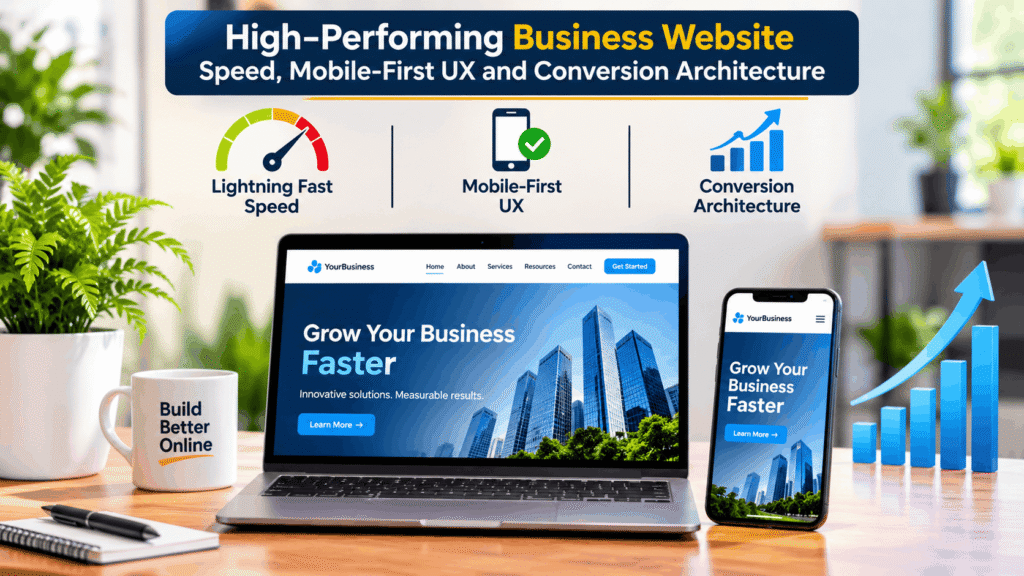
A high-performing business website passes three tests. It loads fast on real mobile connections. It can be found and understood by search engines and AI tools. And it turns the right visitors into enquiries. Design matters, but only in service of those three outcomes. Five pillars make it happen.
Pillar 1: Speed and Core Web Vitals
Core Web Vitals in Plain Language
Google measures page experience through three Core Web Vitals:
- Largest Contentful Paint (LCP): how quickly the main content appears. Aim for under 2.5 seconds.
- Interaction to Next Paint (INP): how quickly the page responds to a tap or click. Aim for under 200 milliseconds.
- Cumulative Layout Shift (CLS): how much the layout jumps while loading. Aim for below 0.1.
These are not vanity scores. Slow pages lose visitors before the first headline appears, and page experience is one of the signals Google weighs.
What Slows a Business Websites Down
The usual culprits are auto-playing sliders, uncompressed images, bulky page builders loaded with plugins, chat and tracking scripts firing all at once, and cheap shared hosting. Fixing these often delivers bigger gains than a full redesign. Start with a free PageSpeed Insights test on your three most important pages; it shows exactly what is holding each one back.
Pillar 2: Mobile-First, Not Just Mobile-Friendly
A mobile-friendly site is a desktop site that shrinks to fit a phone. A mobile-first site is designed for the phone first and expanded for larger screens.
Design for the Thumb
Keep navigation and calls to action within easy thumb reach. For many Indian audiences, a tap-to-call or WhatsApp button is the fastest path to an enquiry, so make it impossible to miss. Forms should trigger the right mobile keyboard, support autofill and ask for as few fields as possible.
Design for Real Network Conditions
Serve properly sized images in modern formats such as WebP or AVIF, lazy-load what sits below the fold, and test on mid-range Android phones, not just the latest flagship.
The payoff is measurable. DigiChefs built a custom, mobile-first website for James Electricals, a contracting business with over four decades of offline reputation but almost no online presence. The new site achieved a mobile PageSpeed score of 98 and an SEO score of 100. That is the kind of benchmark worth asking any website development company in Mumbai to commit to before a project starts.
Pillar 3: Information Architecture That Routes Every Visitor
One Service, One Page
Cramming every service onto a single page confuses visitors and search engines alike. Dedicated pages let each service rank for its own searches and answer its own buyer’s questions. Clear menus, breadcrumbs and internal links between related services then help both people and crawlers move through the site.
Pathways by Audience
Different buyers need different entry points. James Electricals serves everyone from homeowners to factory operations heads, so its site gives six service lines their own pages and maps each industry it serves to relevant messaging. Every visitor can quickly find the page meant for them.
Pillar 4: Conversion Architecture
Traffic without enquiries is just a cost. Conversion has to be designed in, not bolted on.
Put Trust Above the Fold
Years in business, projects completed, client logos and certifications should be visible without scrolling. James Electricals’ homepage opens with an animated stats counter for exactly this reason. Short testimonials with a name, role and company carry far more weight than anonymous praise.
Make Lead Capture Smarter
Generic forms convert poorly and qualify nobody. In the Coign Consulting website rebuild by DigiChefs, generic forms were replaced with redesigned inquiry forms and an AI-powered chatbot that engages visitors and qualifies leads in real time.
Nurture After the Form
Most B2B buyers are not ready to sign on day one. Personalised, automated email follow-ups keep your brand present while they decide, which is why Coign’s new site was paired with an email nurture flow.
Pillar 5: Built to Be Found and Built to Scale
Technical SEO From Day One
SEO should be part of the build, not a patch afterwards. That means semantic HTML with one clear H1 per page, clean URLs, schema markup for your organisation and services, an XML sitemap, and content that does not depend entirely on JavaScript to render. The same signals help AI Overviews and AI search tools understand and cite your pages.
Easy to Manage, Secure and Ready to Grow
A modular CMS lets your team update pages without calling a developer. SSL, regular updates and security monitoring protect both visitors and rankings. An architecture that supports new integrations, such as a CRM, chatbot or analytics stack, saves an expensive rebuild later.
A Quick 8-Question Self-Audit
- Does your homepage load in under three seconds on a mid-range phone using mobile data?
- Does your site pass Core Web Vitals in Google Search Console?
- Can a visitor call or message you in one tap?
- Does every core service have its own page?
- Can a first-time visitor tell what you do and who you serve within five seconds?
- Are trust signals visible without scrolling?
- Does your site use schema markup?
- Can your team update content without a developer?
If you answered “no” to three or more, your website is likely costing you enquiries.
Conclusion
In 2027, a business website is no longer a brochure. It is your hardest-working salesperson and the source AI tools read before describing you to buyers. Get speed, mobile experience, structure and conversion right, and every other channel, from SEO to paid media to social, performs better because it lands somewhere built to convert. Start with the self-audit above, fix the biggest gaps first, and measure enquiries rather than visits.