


I’ve killed more guest post pitches before they were ever written than I’ve actually sent. That’s not a productivity problem. It’s the point. Every hour a writer spends drafting a pitch for a site that turns out to be a content farm, a link scheme, or a dead-traffic domain is an hour that produced nothing but a rejected email or, worse, a published link you’ll want removed six months later.
This is the checklist I run before any pitch goes out, whether the target is a five-year-old niche authority or a newer multi-niche site like Zavalio Com. Twelve questions, five minutes each if you’re fast, and you’ll know whether a pitch is worth writing.
Why Most Guest Post Vetting Stops Too Early
Most advice on this topic stops at domain authority and a quick look at the homepage. That’s not vetting. That’s a glance. Domain authority tells you how many links point at a site, not whether those links are worth anything, whether the site is actively maintained, or whether your placement will still be live and indexed in a year.
The gap I keep seeing in client campaigns is teams treating “DA 30+” as a checkbox instead of asking the harder questions: is this site actually indexed right now, does its editorial process involve a real human, and would I be comfortable defending this placement if a client asked me to explain it. Those are the questions this checklist answers.
The 12-Question Checklist
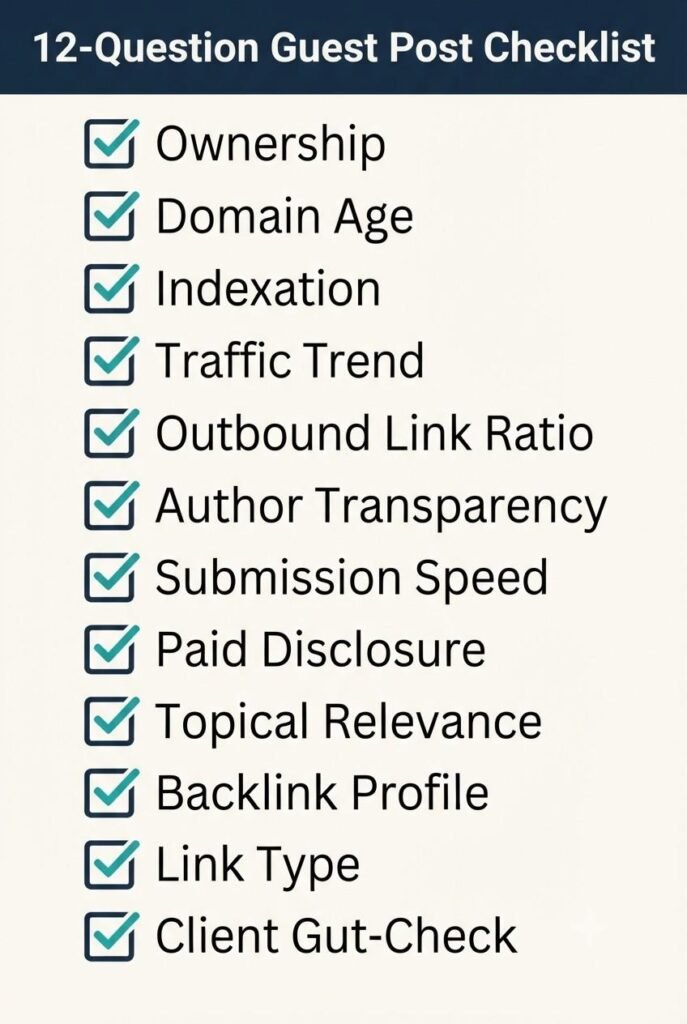
Run through these in order. If you hit a hard no on questions 1 through 4, stop. The rest won’t matter.
- Can I identify who owns or runs this site? Look for an About page, named editorial staff, or a company registration. A site with zero visible ownership information is a site you can’t hold accountable if something goes wrong.
- How old is the domain, and has it changed ownership recently? A domain that changed hands in the last year, especially one with a sudden traffic spike right after, is a common sign of an expired-domain link scheme rather than an organic publishing site.
- Are recent articles actually indexed in Google? Run a
site:search for the domain plus the current year. If the results are thin or dominated by old content, the site isn’t being actively crawled and rewarded, which means your link won’t be either. - Is organic traffic growing, flat, or declining? You don’t need a paid tool for a rough read. A free trend check through a tool like Google Trends for branded search volume, or a quick look at a free-tier SEO browser extension, tells you which direction the site is heading.
- What’s the outbound link ratio per article? Open three recent articles and count outbound links. If every article is stuffed with eight or more outbound links to unrelated commercial sites, you’re looking at a link farm, not a publication.
- Are contributor names and bios visible on published articles? Named, identifiable authors are a baseline trust signal. Anonymous or generic “Admin” bylines across every post is a red flag, not a minor style choice.
- How does the site handle submissions, and how fast? Same-day, no-edit approval on a first pitch is one of the strongest warning signs in this whole checklist. It usually means nobody is actually reading what gets published.
- Does the site ever charge for placement, and is that disclosed? Paid placement isn’t automatically disqualifying, but undisclosed paid links violate search engine guidelines and can create risk for both you and the site. Ask directly if pricing comes up.
- Is this site topically relevant to what you’re pitching? A finance article buried on a site that’s 90 percent lifestyle and travel content carries less contextual weight than the same article on a finance-focused publication, even if the finance-heavy site has lower domain authority.
- Does the site’s own backlink profile show signs of a link scheme? A quick check through a free backlink checker for spammy, unrelated inbound links pointing at the domain tells you what company your link would be keeping.
- Will your link be a genuine contextual dofollow link, or will it be nofollowed, sponsored-tagged, or stripped entirely? Ask this before you pitch, not after you’ve written the piece. Some sites promise placement and quietly nofollow every outbound link by default.
- Would you be comfortable if this exact placement showed up in a client’s backlink audit? This is the gut-check question. If you’d need to explain or defend the placement rather than point to it with confidence, that’s your answer.
How I Used This Checklist on Zavalio Com
When I ran this exact checklist against Zavalio Com before pitching it for a client campaign, it cleared questions 1 through 4 without much friction. Named categories, a working guest-contribution pathway, indexed recent content, and no obvious ownership red flags. Where it landed in the middle was on questions 7 and 9. The submission process involved a genuine edit request rather than instant approval, which is a good sign, but the site’s broad topic spread meant the contextual relevance for a narrow finance pitch was weaker than a single-niche finance blog would offer.
That’s the kind of nuanced result this checklist is built to produce. Not a pass or fail, but a clear picture of where a site is strong and where it’s a compromise. You can read the full Zavalio Com review, including the 5-point scorecard I built specifically for multi-niche publishing sites, for the complete breakdown.
What to Do When a Site Fails Questions 1 Through 4
Don’t pitch it. I know that sounds obvious, but I’ve watched writers talk themselves into a pitch anyway because the site “looked professional” or a colleague mentioned it. A polished design says nothing about ownership transparency, domain history, or indexation. Those are separate, checkable facts, and they don’t improve just because the homepage has a nice hero image.
If a site fails on domain age or ownership specifically, treat that as close to a hard stop regardless of how the rest of the checklist scores. Everything past question 4 assumes you’re dealing with a real, accountable publisher. If you’re not, the remaining questions are measuring the wrong thing.
A Common Misconception: “High Domain Authority Means Safe to Pitch”
Domain authority is a backlink-volume metric, not a trust metric. A site can accumulate high authority through years of low-quality, high-volume linking and still fail every other question on this checklist. I’ve seen DA 40+ sites with anonymous bylines, no visible ownership, and an outbound link ratio that reads like a link exchange directory. Authority and accountability are different variables. Check both.
Frequently Asked Questions
How long should vetting a guest post site take? With this checklist, most sites can be evaluated in fifteen to twenty minutes total. Questions 1 through 4 alone take about five minutes and will eliminate most sites you shouldn’t pursue further.
What’s the single biggest red flag on this list? Same-day, no-edit approval on a first-time submission. It’s the clearest signal that no real editorial review is happening, regardless of how the rest of the site looks.
Do I need paid tools to run this checklist? No. Every question here can be answered with a Google site: search, a free-tier backlink checker, and a manual read of a few recent articles. Paid tools speed this up but aren’t required.
Should I still pitch a site that fails one or two questions? It depends which ones. A weak score on topical relevance (question 9) might still be worth a pitch for visibility. A fail on ownership transparency (question 1) or domain history (question 2) should end the pursuit regardless of other scores.
How is this different from just checking domain authority? Domain authority measures link volume pointed at a site. It says nothing about whether that site is actively maintained, editorially reviewed, topically relevant to your pitch, or safe to associate your brand with. This checklist checks the things DA doesn’t.
Can I use this checklist for sites other than guest-posting blogs? Yes. It works for any placement opportunity involving an outbound link, including sponsored content, resource-page mentions, and directory listings, though questions 7 and 8 matter less for non-editorial placements.
Download the Checklist
Run through these twelve questions on paper or in your head enough times, and they become second nature. Until then, grab the free Guest Post Site Vetting Checklist. It has all twelve questions laid out with space to score each site, so you can compare pitch targets side by side instead of relying on memory.