

Executive Summary
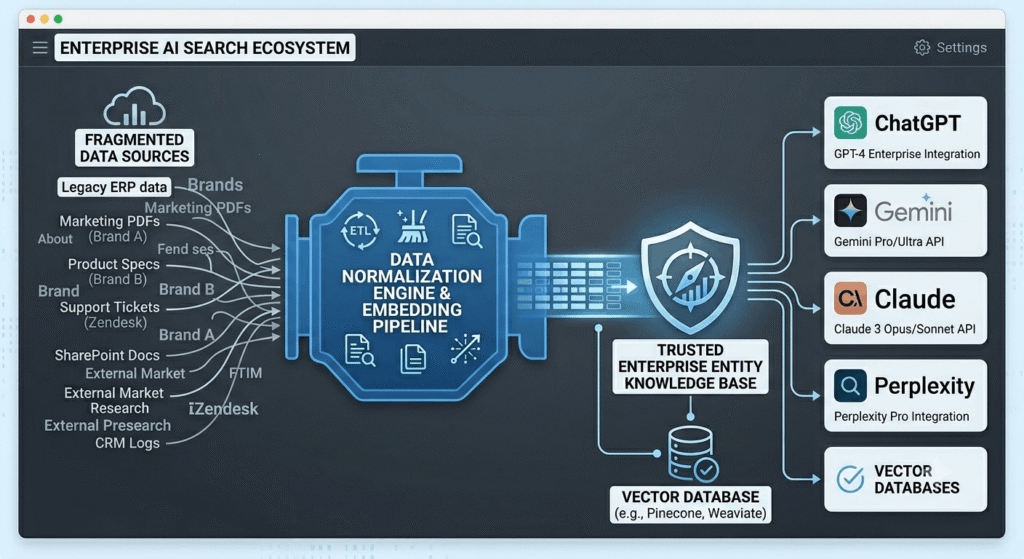
AI search engines no longer rank pages solely by keywords and backlinks. Systems such as BrandRank.ai, ChatGPT, Gemini, Claude, Perplexity, and Google AI Overviews increasingly rely on entity understanding, structured data, retrieval systems, and knowledge graphs to determine what information is trustworthy and worth citing.
This shift creates a new challenge for enterprise organizations: brand inconsistency becomes an AI visibility problem.
When a company appears as:
- Acme Inc.
- Acme Incorporated
- ACME
- io
- Acme Software
AI systems may interpret these as separate entities rather than a single authoritative brand.
BrandRank.ai normalization transformation rules address this challenge by transforming fragmented brand data into a machine-readable, semantically consistent representation that answer engines can confidently understand and retrieve.
This guide explains:
- What normalization transformation rules are
- How they influence AI search visibility
- The technical architecture behind enterprise implementations
- Schema and JSON-LD strategies
- RAG integration patterns
- Common implementation mistakes
- Future-proof optimization techniques
Why Data Normalization Matters in AI Search
Traditional SEO focused on documents. AI search focuses on entities.
Large language models build internal representations from:
- Structured data
- Web content
- Knowledge graphs
- Vector databases
- Retrieval systems
- Third-party references
When entity information is inconsistent, AI systems must guess.
Every guess increases the probability of:
- Hallucinations
- Incorrect citations
- Brand confusion
- Lost visibility
- Reduced answer-engine trust
Normalization reduces ambiguity by ensuring every brand signal points to the same canonical entity.
Practical Takeaway
If your organization maintains:
- Multiple CMS environments
- Product catalogs
- CRM systems
- Regional websites
- Partner databases
You already have a normalization problem.
What Are BrandRank.ai Normalization Transformation Rules?
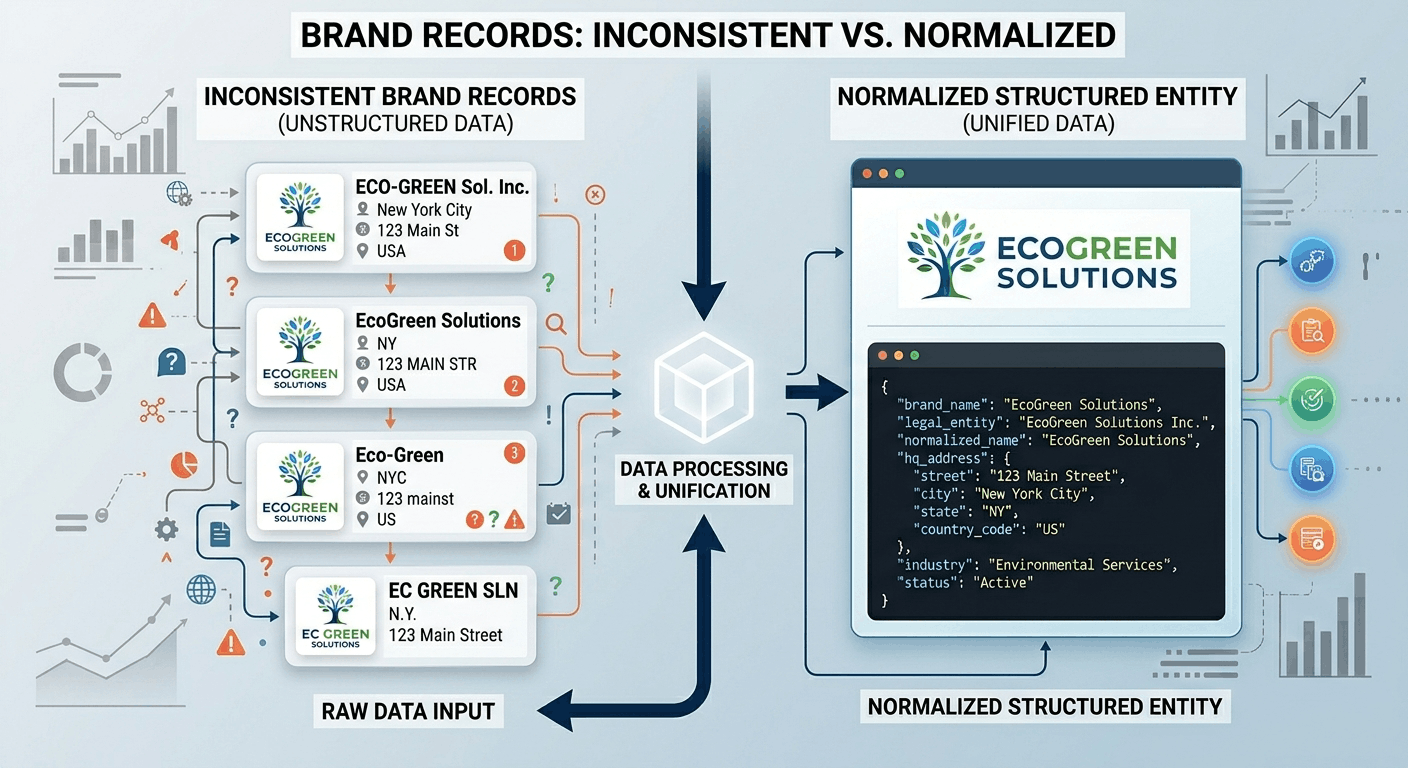
BrandRank.ai normalization transformation rules are a framework for converting inconsistent brand information into standardized entity representations suitable for AI systems.
Think of them as a translation layer between human-created data and machine-readable knowledge.
Core Objective
Transform:
Acme Inc.
ACME
Acme Incorporated
acme.io
Into:
{
“entity_id”: “acme_global”,
“canonical_name”: “Acme”,
“website”: “https://acme.com”,
“aliases”: [
“Acme Inc.”,
“Acme Incorporated”,
“ACME”
]
}
The goal is entity consistency across every system.
The Five Foundational Normalization Rules
1. Case Normalization
Different capitalization patterns create duplicate entities.
Before
ACME
Acme
acme
After
Acme
Why It Matters
Tokenization systems treat text statistically.
Reducing variation improves entity confidence scores and semantic matching.
2. Legal Suffix Standardization
Organizations appear with numerous legal variations.
Examples:
LLC
Ltd
Inc.
Corporation
GmbH
PLC
Before
Acme Inc.
Acme Corporation
After
Acme
Unique Insight
Many enterprises normalize internally but forget external citations.
AI systems often encounter the external version first.
Your public schema should reconcile both representations.
3. Special Character Transformation
Brands frequently use:
&
+
–
_
®
™
Examples:
A&B
A and B
A+B
Canonicalization prevents vector fragmentation.
Practical Rule
Maintain:
{
“canonical”: “A and B”,
“aliases”: [“A&B”, “A+B”]
}
4. Whitespace Standardization
Whitespace inconsistencies appear trivial but create indexing problems.
Before
BrandRank AI
BrandRank AI
BrandRankAI
After
BrandRank AI
This improves entity resolution pipelines and similarity matching.
5. Domain Harmonization
Many organizations maintain:
brand.com
www.brand.com
brand.ai
products.brand.com
AI retrieval systems need one authoritative source.
Best Practice
Define:
{
“canonical_domain”: “brand.com”
}
Then connect related assets through structured relationships.
How AI Systems Process Normalized Data
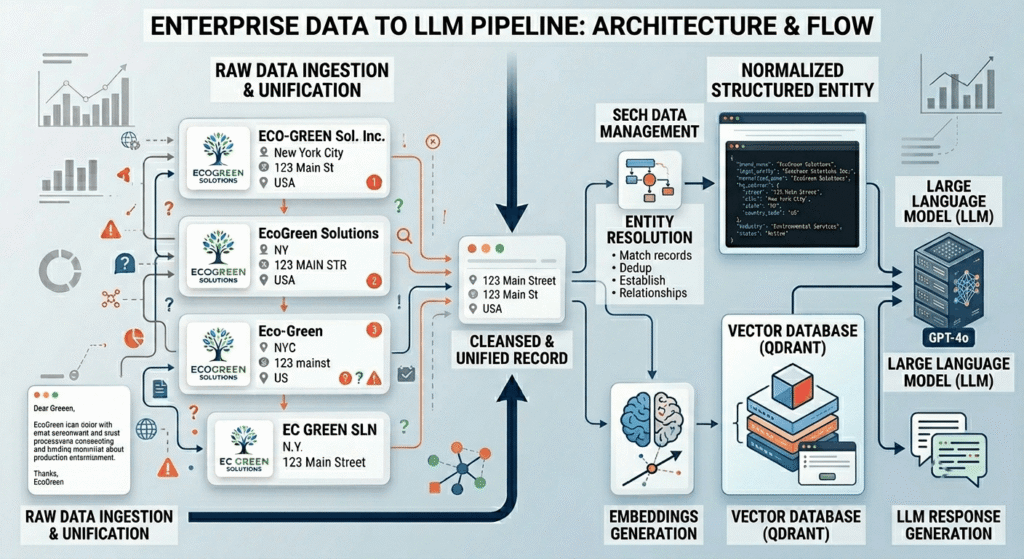
Understanding the AI pipeline is more important than memorizing transformation rules.
Simplified Flow
Raw Data
↓
Normalization
↓
Entity Resolution
↓
Schema Enrichment
↓
Vector Embeddings
↓
Retrieval Systems
↓
LLM Response Generation
What Competitors Usually Miss
Most SEO discussions stop at schema markup.
In reality:
Schema is only one component.
Normalization affects:
- Retrieval quality
- Embedding quality
- Knowledge graph consistency
- Entity confidence
- Citation likelihood
Entity Resolution: The Hidden Layer Behind AI Visibility
Entity resolution determines whether multiple references represent the same thing.
Example:
Apple
Apple Inc.
Apple Computer
An AI system must decide:
- Same entity?
- Different entity?
- Related entity?
Normalization dramatically improves resolution accuracy.
Enterprise Recommendation
Create an internal entity registry.
Example:
{
“entity_id”: “apple_company”,
“canonical_name”: “Apple”,
“aliases”: [
“Apple Inc.”,
“Apple Computer”
]
}
This becomes the source of truth across:
- CMS
- CRM
- Product databases
- Analytics systems
- AI retrieval systems
JSON-LD Architecture for AI-Ready Brands
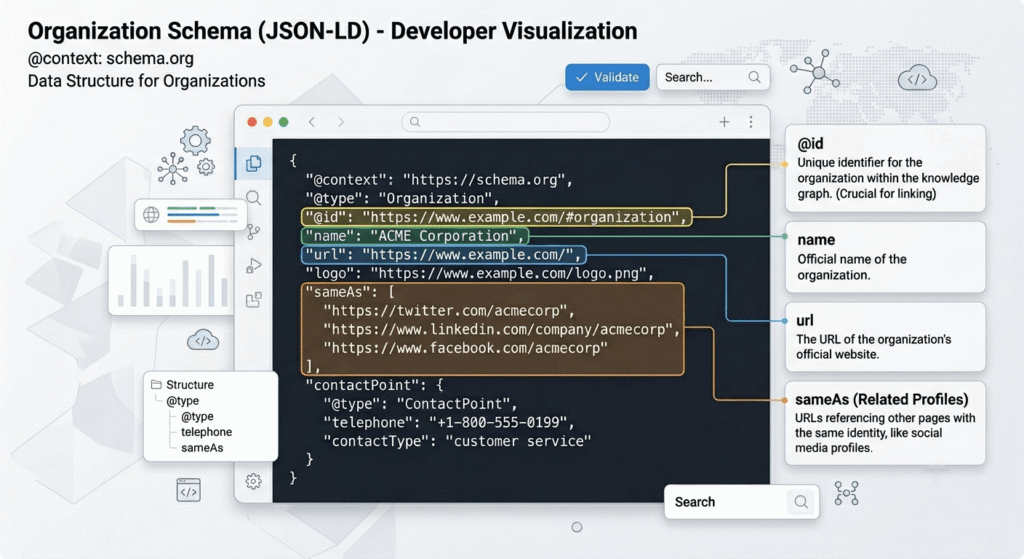
JSON-LD remains the most widely recognized structured data format for machine-readable entities.
Recommended Organization Schema
{
“@context”: “https://schema.org”,
“@type”: “Organization”,
“@id”: “https://brand.com/#organization”,
“name”: “Brand Name”,
“url”: “https://brand.com”,
“sameAs”: [
“https://linkedin.com/company/brand”,
“https://x.com/brand”
],
“logo”: “https://brand.com/logo.png”
}
Critical Fields
name
Canonical entity name.
url
Authoritative source.
sameAs
Connects identity across platforms.
@id
Persistent entity identifier.
logo
Visual entity recognition signal.
Building an AI-Optimized RAG Pipeline
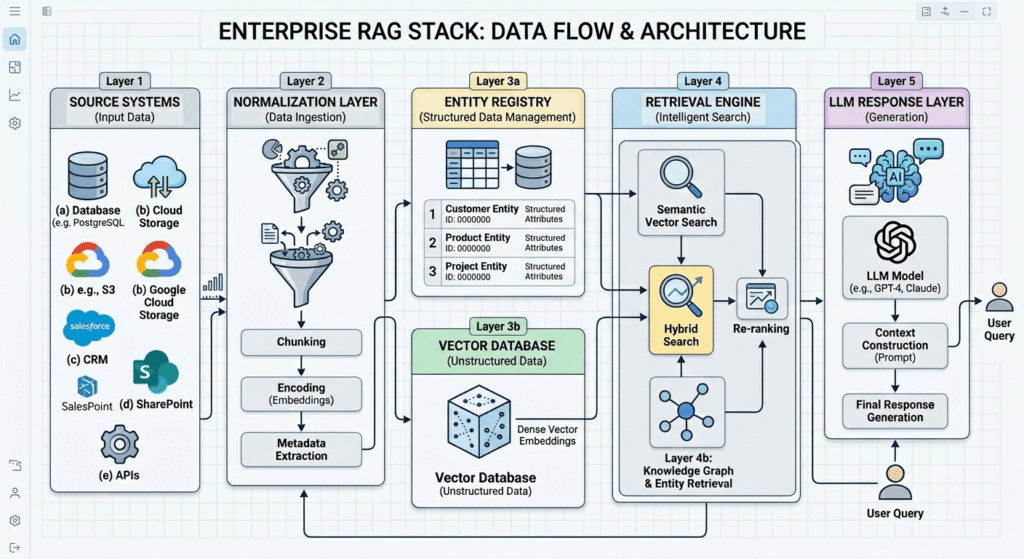
Normalization becomes even more important inside Retrieval-Augmented Generation systems.
Without normalization:
Product A
Product-A
Product A™
may generate separate vectors.
With normalization:
Product A
produces stronger semantic clustering.
Recommended Architecture
Source Systems
↓
Normalization Engine
↓
Entity Registry
↓
Schema Layer
↓
Embedding Pipeline
↓
Vector Database
↓
RAG Application
Benefits
- Higher retrieval precision
- Reduced hallucinations
- Better citation consistency
- Lower maintenance costs
Example Transformation Workflow
Dirty Source Data
{
“company”:”ACME INC.”,
“site”:”www.acme.com”,
“twitter”:”@AcmeOfficial”,
“product”:”Acme CRM™”
}
Normalized Output
{
“entity_id”:”acme”,
“company”:”Acme”,
“canonical_domain”:”acme.com”,
“social_profiles”:[
“https://x.com/AcmeOfficial”
],
“products”:[
“Acme CRM”
]
}
AI-Ready JSON-LD
{
“@context”:”https://schema.org”,
“@type”:”Organization”,
“name”:”Acme”,
“url”:”https://acme.com”
}
Common Mistakes Enterprise Teams Make
Mistake #1: Treating AI SEO Like Traditional SEO
AI systems evaluate entities, not just pages.
Mistake #2: Schema Without Normalization
Recent industry analysis suggests schema alone may not automatically increase AI citations if underlying entity signals remain inconsistent.
Schema should reinforce normalized data—not compensate for poor data quality.
Mistake #3: Multiple Sources of Truth
Different teams maintain different versions of:
- Company names
- Product names
- Service descriptions
This creates AI confusion.
Mistake #4: Ignoring Internal Systems
Many organizations optimize public websites while leaving:
- CRM data
- Product databases
- Knowledge bases
unstructured and inconsistent.
Measuring Success
Track normalization using measurable KPIs.
Entity Consistency Rate
Canonical References
Total References
Citation Accuracy
Monitor:
- ChatGPT
- Gemini
- Perplexity
- Claude
- Google AI Overviews
for entity correctness.
Retrieval Precision
Measure:
Relevant Documents Retrieved
Total Retrieved Documents
inside RAG environments.
Hallucination Reduction
Track:
- Incorrect brand descriptions
- Wrong product associations
- Outdated company information
over time.
Future Trends: Beyond Schema and Into AI Knowledge Layers
The next evolution is moving from isolated schema markup toward machine-readable knowledge ecosystems.
Emerging approaches include:
- Knowledge graphs
- AI manifests
- NDJSON data feeds
- Semantic APIs
- LLM-specific linked-data standards such as LLM-LD drafts
Strategic Implication
Organizations that build normalization frameworks today will be positioned to adapt faster as AI retrieval systems become more structured and entity-driven.
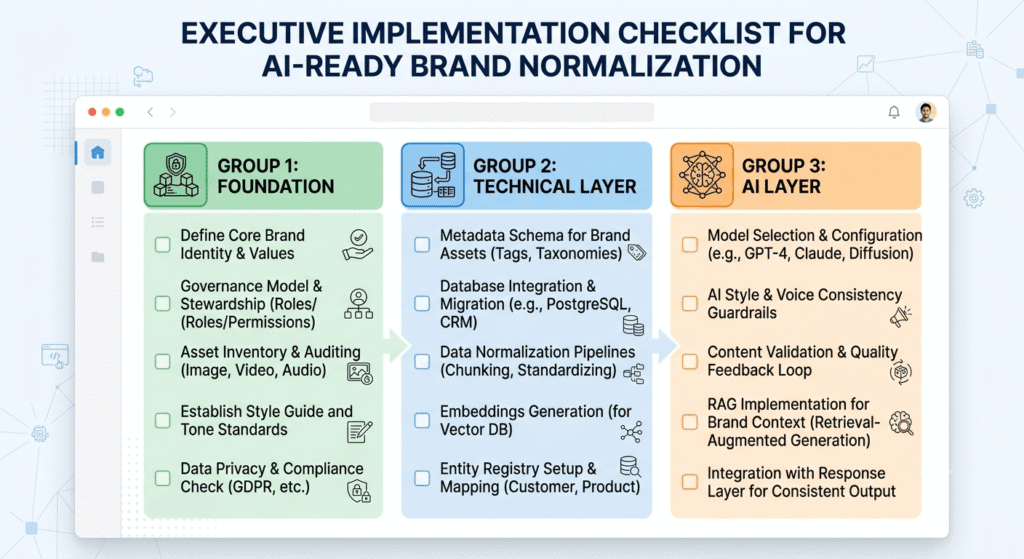
Implementation Checklist
Foundation
✓ Create canonical brand definitions
✓ Standardize naming conventions
✓ Build alias mapping rules
✓ Normalize legal suffixes
✓ Normalize domains
Technical Layer
✓ Implement JSON-LD
✓ Create entity IDs
✓ Establish schema governance
✓ Validate structured data
✓ Connect sameAs relationships
AI Layer
✓ Normalize retrieval sources
✓ Standardize embeddings
✓ Maintain knowledge graph consistency
✓ Audit AI-generated brand references
✓ Measure citation accuracy
Conclusion
BrandRank.ai normalization transformation rules are ultimately about creating algorithmic trust.
The organizations that succeed in AI search will not necessarily be those publishing the most content. They will be the ones whose data is easiest for machines to understand, reconcile, retrieve, and cite.
For enterprise SEO leaders, marketing technologists, and data engineers, normalization should be viewed as foundational infrastructure—not an optimization tactic.
A clean entity model improves:
- AI visibility
- Citation accuracy
- RAG performance
- Knowledge graph integrity
- Brand control
In the AI-first search era, normalization is becoming the bridge between brand authority and machine understanding.