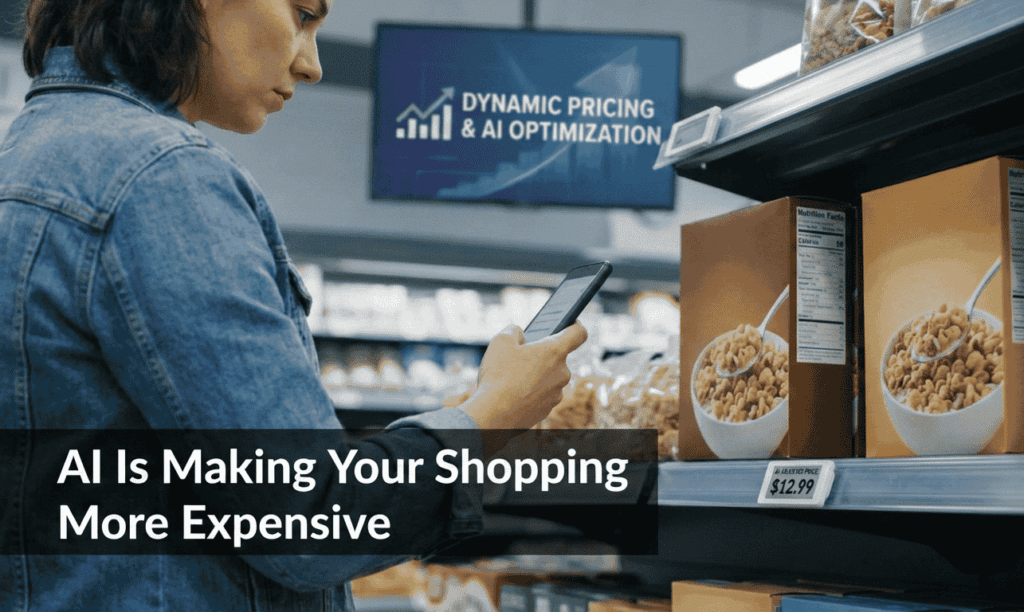

The corporate greed is reaching unimaginable levels. Studies show that companies are using AI to set personalized prices according to each person’s profile. Companies may be using your data against you. It is called surveillance pricing, and that is when a company sets the price you see based on your unique habits and demographics.
McKinsey Study Report on Surveillance Pricing
A McKinsey study estimated that AI based pricing systems can increase a company’s revenue by up to 15% we found big retailers with little regional competition can extract large profits simply by adjusting prices of essential goods like food items. Likewise, investigations by Consumer Reports detected differences of up to 160% in the price of the same online product depending on the buyer’s ZIP Code. Surveillance pricing, that’s when companies use someone’s personal data, like browsing even credit history, to sell them a product at a different price.
Independent analysis revealed that charge up to 6% more when the user’s phone battery is below 50%. Faces accusations from a Belgian newspaper that it can see riders phone battery levels and changes rider fares based information even in airline tickets.
Wall Street Journal Report on Airlines AI Pricing Strategy
A report by the Wall Street Journal documented that some airlines achieved up to a 20% increase in annual revenue after implementing AI based dynamic pricing systems. Next time you go online to purchase an airline ticket, there’s a chance that the price you see was influenced by artificial intelligence. So how companies are using AI to charge you more.
The concept of dynamic pricing is not new. It dates back to the US airline industry during the 1970s when ticket prices were still regulated by the federal government. With the approval of the Airline Deregulation Act of 1978 airlines gained full freedom to set fares, and this transition opened the door to the creation of the first yield management systems. On October 24 1978 President Carter signed the Airline Deregulation Act.
American Airlines developed one of the pioneering models known as dynamo, which analyzed demand patterns and automatically adjusted the prices of available seats. By 1985 The company reported revenue increases between 6% and 8% – solely thanks to these strategies. And by the end of the decade, almost all commercial airlines were applying similar mechanisms.
This model was based on relatively simple but innovative principles for the time, raising prices as the plane filled up, increasing fares for those who purchased close to the flight date, and offering discounts only when occupancy needed to be stimulated. The practice worked so well that by the 1990s it expanded to the hotel sector, car rentals and rail transport service. This consolidation reinforced the idea that prices should not be static, but should adapt to real time demand. And major hotel chains still use this today.
AI Pricing Strategy in Hotel Industry
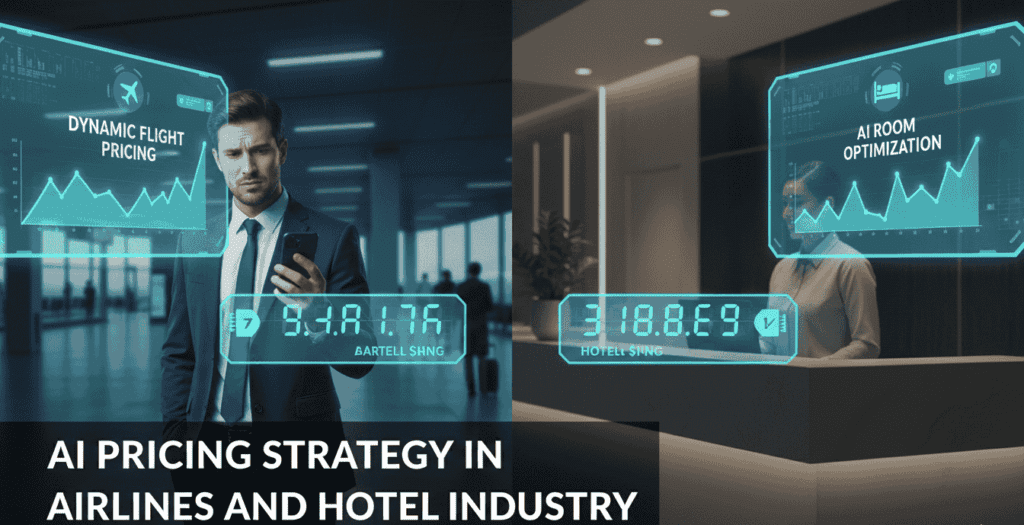
Are you wondering why it’s so expensive to stay at a hotel right now? What if I told you the rates that many hotels are charging are artificially inflated in the mid to late 1990s Hilton became one of the first chains to systematically adopt the dynamic pricing model inspired by airlines. By 1997 the chain was already using a centralized rate setting system that compared projected occupancy, historical demand and seasonal booking patterns in real time.
The change had an immediate impact, according to corporate reports from the time, Hilton managed to increase its revenue per available room by nearly 6% annually for three consecutive years. It also reduced empty days by approximately 12% in high demand urban hotels such as Los Angeles, Chicago and New York. The principle was simple but powerful.
If a hotel detected that 70% of its rooms were booked for a long weekend, the price rose automatically. Conversely, if projected occupancy fell below 40% temporary discounts were activated. But this did not stop there. With the arrival of E commerce in the mid 1990s a second phase of expansion began. Amazon, one of its pioneers, began experimenting with price variations based on browsing data, search history and user behavior.
Uber’s AI Pricing Strategy
If you’re familiar with Uber, you’re probably familiar with the term surge pricing, but a new report claims that Amazon may use surge pricing as well. In the year 2000 for example, specific cases became public showing how the same DVD could be sold with a 6% markup to one customer and not to another.
Afterward, the company described these price differences as controlled tests. However, these experiments demonstrated something crucial. Digital commerce made it possible to modify prices automatically, individually and silently, without the consumer noticing between 2002 1010 the massive collection of data such as cookies, IP, location and purchase frequency transformed how online retailers tracked consumers.
Using this information, they developed models that adjusted prices based on each user’s estimated conversion probability, powered by algorithms and artificial intelligence. Surge pricing is now being used across a growing number of consumer industries. Theme parks, restaurants, retail outlets and rock concerts.
Academic studies from the time recorded variations between 5 and 15% for identical products viewed by different users. The message was becoming clear, price personalization was no longer experimental and was beginning to become a structural practice of digital commerce. But nothing accelerated the normalization of dynamic pricing, as much as the arrival of Uber in 2012 the company popularized the concept of surge pricing, a model that automatically increased fares when demand exceeded supply.
The algorithm analyzed variables such as the number of available drivers, local events, weather conditions and time of day. Based on these factors, it could multiply the cost of a ride by up to 200% during peak moments in January 2020. Say, an Uber ride from New York City’s John F Kennedy Airport to midtown Manhattan costs about $50 today, based on the average price rise of Uber rides, that same trip could be $75 about a 50% jump, although the company argued that this tactic encouraged drivers to go out when they were most needed.
Later studies questioned its effectiveness. Research showed that the system significantly increased fares without an equivalent increase in driver earnings between 2022 and 2025 independent investigations documented that Uber’s take rate in the United States rose from 32% to 42% this considerable increase reflected how the algorithm prioritized corporate profitability rather than balancing supply and demand.
By the mid 2000s millions of users had become familiar with the idea that prices could double or triple at any moment, and they had accepted it without questioning it. Thus, the stage was set for other industries to begin adopting similar models, but the real leap in complexity came after 2020 when companies began integrating advanced artificial intelligence into their pricing systems. Big changes are happening.
At Delta Airlines, we announced that it’s ramping up their dynamic pricing, and they will actually rely on artificial intelligence to forecast demand for specific routes and set what passengers will pay repairs. Unlike previous models, which relied mainly on demand levels, these new algorithms could analyze millions of data points simultaneously.
They estimated how much each customer was willing to pay. It was no longer about adjusting prices by hour or city, but by individual. AI learned the user’s history, geographic location, how many times they searched for the same item, and even how long they left a product in the cart. Some studies found that iPhone users received systematically higher prices.
For example, variations could reach 15% for specific products and services due to the statistical association between Apple devices and greater purchasing power.
Surge Pricing for Apple Products
Some online companies even boost the price if a customer is using an Apple product. But the most controversial development came between 2022 and 2025 with the adoption of dynamic pricing in digital supermarkets and grocery delivery apps, a recent study on instar cards practices through the use of AI tools, products could vary their price different users at the same time.
Additionally, between 74 and 75% of the products analyzed show different prices today. The practice of dynamic pricing, powered by advances in artificial intelligence, has spread to all industries. For example, in 2025 several supermarkets in the United States began replacing traditional paper price tags with digital shelf labels, a technological shift led by major chains such as Walmart and Kroger.
Groceries and Retail Shopping Also Became More Expensive
Kroger, the largest grocery store chain in the country, is facing questions for using electronic price tags with the ability to change prices at the push of a button. Walmart specifically announced that it plans to deploy these labels in its 2300 stores by 2026 The problem is that these digital labels allow prices to be changed instantly for 1000s of items in just a few seconds.
This enables retailers to secure better profits depending on the type of shopper or their purchasing power as these practices have expanded, ethical concerns have grown. Current systems can charge more to a user simply because they live in an affluent neighborhood or use a high end device. They can also adjust prices based on in app behavior that reveals impulsive buying habits.
Although companies defend these models as mechanisms of efficiency and optimization, critics argue that they often deepen economic inequalities. Price becomes an instrument of individual segmentation, where the final cost depends more on the buyer’s profile than on the product itself.