
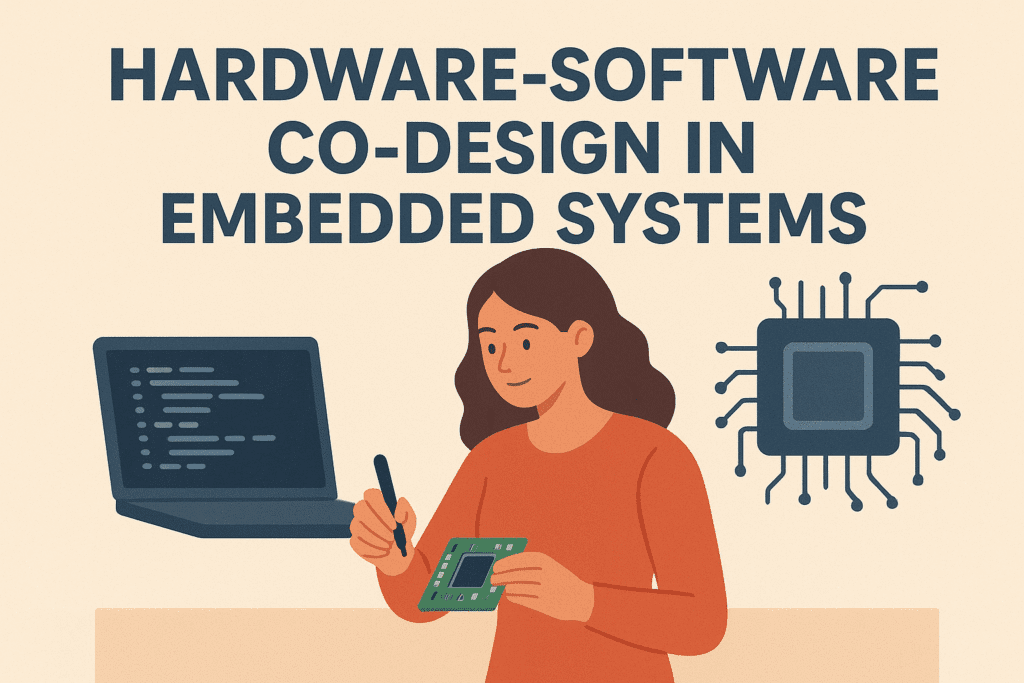

The field of embedded systems has advanced significantly from the days when software and hardware were designed as distinct components. The sophistication of the current applications necessitates seamless interconnection whereby the software and hardware components work in unison since the design inception. This collaborative approach is known as hardware-software co-design, which means a dramatic shift in how engineers build complex systems.
Co-design recognizes that peak performance is achieved by having the pair of domains influence each other throughout the entire lifecycle of development, instead of understanding hardware as a fixed platform against which software should be adjusted. The comprehensive approach is now essential in coming up with embedded system company that meet the demanding requirements of modern applications without compromising on efficiency, reliability, and cost-effectiveness.
1. Early Architecture Planning Sets the Foundation
Having a common architecture vision from the start of the project is essential to effective hardware-software co-design. Engineers are supposed to engage software architects in hardware decisions as early as the planning of the process is done. Through collaboration, hardware functionality and program requirements are perfectly synchronized, eliminating any costly redesign requirements later on in the product development cycle.
The primary objectives of the initial planning sessions should be the development of specifications of communication between parts of the hardware and software, identifying the performance-intensive paths, and understanding the system behavior as a whole. Teams build a strong foundation that facilitates effective growth and lowers the likelihood of integration issues by devoting time to thorough upfront preparation. This proactive strategy turns possible conflicts between software requirements and hardware constraints into chances for creative solutions.
2. Performance Requirements Drive Design Decisions
The foundation of a successful co-design process is an understanding of and documentation of exact performance criteria. Teams should establish clear performance goals in terms of processor speed, power consumption, memory usage, and real-time response behavior, before committing to an architecture. These requirements must consider the needs of the current state as well as those of the future upgrading and the scalability. Performance analysis must consider the behavior of the complete embedded solutions, including edge cases and worst-case scenarios that may impose a load on software or hardware. During the design stage, frequent performance modeling and simulation would help to validate that the chosen architecture would meet all requirements. This objective-based method of development reduces risks in development and yields more predictable outcomes because design decisions are not made based on guesses.
3. Communication Interfaces Demand Careful Consideration
Crucial bottlenecks that have the power to make or break system performance are the interfaces between hardware and software components. The ability to design efficient means of communication requires a deep understanding of the software architectural patterns and hardware capabilities. Engineers need to weigh the issues of data throughput and latency requirements, and power consumption with the complexity of the implementation when selecting interface protocols.
In addition to present requirements, future extensibility and maintenance requirements should be taken into account while selecting communication channels. Robust error handling, and flow control methods, as well as transparent abstraction layers that separate implementation specifics from higher-level software components are all components of a well-designed interface. Software and hardware components may be independently developed and tested thanks to well-designed interfaces, which also guarantee a smooth transition between the two.
4. Resource Allocation Requires Strategic Thinking
Resource management in co-design requires the making of intentional decisions regarding the distribution of processing and memory power and peripheral capabilities, both on the hardware and software implementations. Some of the variables that should be considered during this process of allocation include development cost, power consumption, flexibility requirements, and time-to-market constraints.
Some functions would be better executed by specialized hardware because of performance reasons, whereas other functions would be better executed by software implementation owing to its flexibility and maintainability. It is important to find the compromised balance between meeting the needs of the system and ensuring that development complexity and cost are kept within the reach of the sustainable range. It’s also important to think about dynamic resource allocation techniques, which let the system modify resource utilization according to workload characteristics and existing operational circumstances.
5. Testing Strategies Must Address Both Domains
In hardware-software co-design, thorough testing necessitates advanced techniques that confirm the behavior of individual components as well as the overall performance of the system. Co-designed systems cannot be validated using traditional testing methods that only concentrate on software or hardware. Testing frameworks that can replicate real-world operating circumstances and validate system behavior in a variety of situations must be created by teams. This covers error-handling mechanism verification, validation of real-time performance requirements, and stress testing in harsh environments. Managing the complexity of testing interconnected systems requires the use of automated testing tools and continuous integration techniques. Teams may find and fix problems before real hardware is ready through early testing with simulation and emulation platforms, which speeds up the development process overall.
6. Documentation Bridges the Knowledge Gap
Throughout the co-design process, thorough and unambiguous documentation is the key communication channel between the software and hardware development teams. In addition to standard standards, this documentation has to provide comprehensive explanations of the interface, timing specifications, power management protocols, and integration recommendations. As requirements and implementations change throughout development, teams may stay in alignment by using living documentation that changes with the design. Engineers with backgrounds in both software and hardware should be able to read and comprehend the documentation; domain-specific language that might cause misunderstanding should be avoided. All team members retain a common grasp of the system architecture as well as implementation specifics thanks to routine documentation checks and updates. Additionally, well-maintained documentation is quite helpful when it comes to future enhancements along with system maintenance.
7. Iterative Development Enables Continuous Refinement
Because hardware-software co-design is so complicated, iterative development technique is crucial to getting the best outcomes. Successful teams accept incremental improvement cycles and quick prototyping instead of trying to perfect the idea in a single pass. Validating design assumptions, finding areas for optimization, and fine-tuning the ratio of software to hardware implementations are all made possible by each iteration. With this method, teams may react swiftly to evolving specifications or unforeseen technical difficulties without abandoning the project as a whole. Frequent milestone reviews guarantee that software and hardware components develop in unison while preserving project momentum.
Conclusion
A paradigm change from sequential handoffs to collaborative innovation is represented by hardware-software vlsi design in embedded system development. It needs clear performance criteria, proper resource allocation, comprehensive testing process, and pre-planning of architecture to achieve success. Most importantly, it requires interdisciplinary collaboration that is beyond the traditional boundaries of engineering. When well done, co-design can create embedded systems that are more performance, efficient, and dependable.